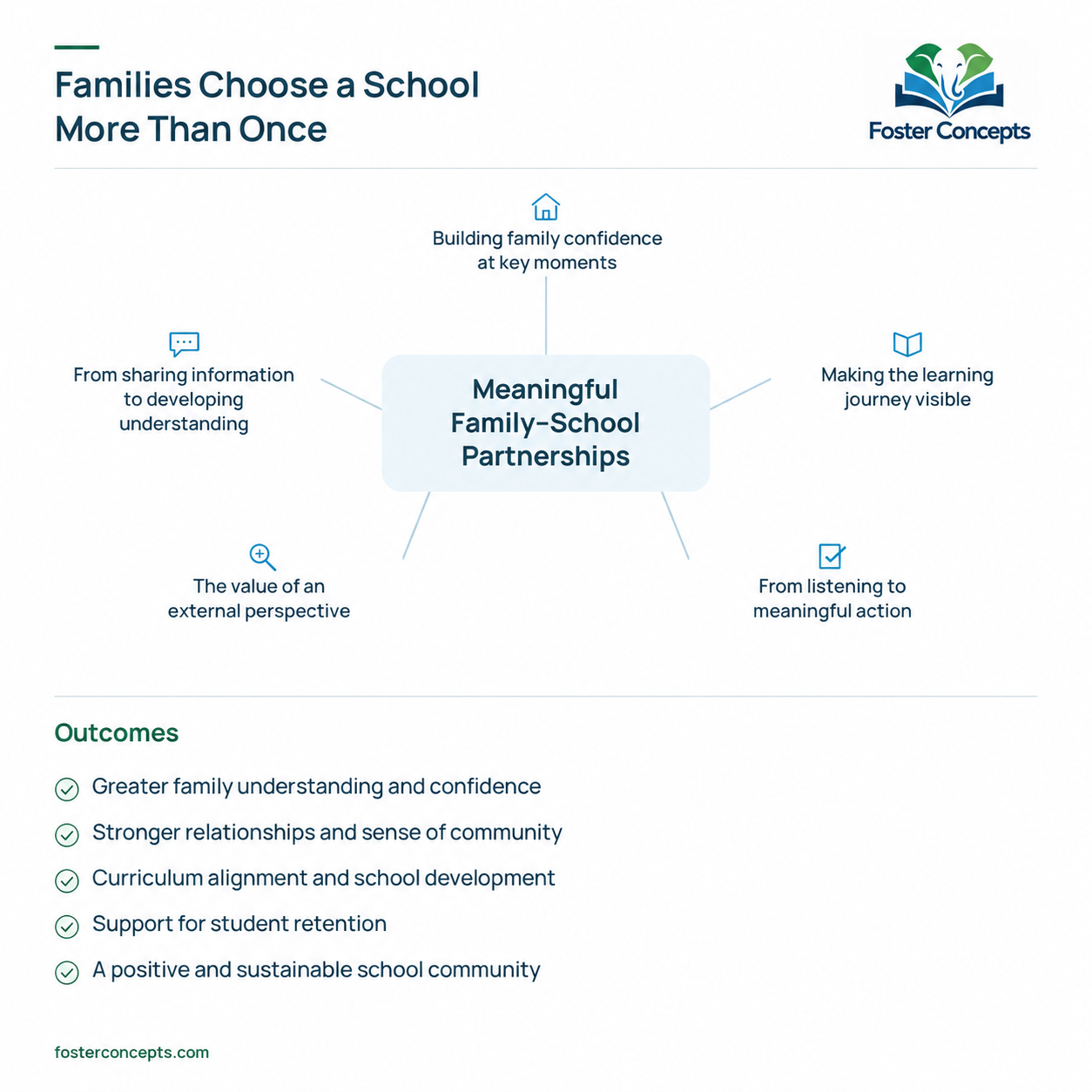
View the summary graphic at full size
Families choose a school more than once.
There is the initial decision, when families consider a school’s values, educational approach and opportunities for their children. But there are also quieter moments throughout a child’s education when families revisit that choice.
When a child moves into a new year group. When questions arise about progress. When expectations change. When the transition from primary to middle school approaches. At these points, families may begin asking whether the school continues to offer the right environment for their child’s learning and development.
These moments can reveal a great deal about how families are experiencing the school, and where confidence is being strengthened or unsettled. They are opportunities to strengthen relationships, build confidence and support the conditions that contribute to student retention. The question isn't whether families have received information about the school’s educational approach. It is whether they understand it, experience its value and feel that their own perspectives have a meaningful place within the school community.
A relationship I have always valued
Throughout my career in education, I have been particularly interested in the relationship between schools and families, and in what becomes possible when both work together around the needs of the child.
My years working in boarding education strengthened this considerably. In that context, it was impossible to separate academic learning from wellbeing, relationships, independence and belonging. Education was something experienced across the whole life of the student.
Being both an educator and a mother has added another perspective to my understanding of school life. As educators, we understand the thinking, planning and professional decisions behind learning experiences. We can see the progression within a curriculum and the reasons behind particular approaches to teaching and assessment.
From a parent perspective, education can feel quite different. We want to know whether our children are progressing, whether they feel known and supported, and whether they are being prepared well for what comes next. And often, we are also trying to make sense of how different education looks from our own experience of school.
Both perspectives matter. And wouldn’t it be wonderful, if this wasn’t a tension but a strength? I have increasingly come to believe that some of the most valuable opportunities for school development arise when we intentionally create space for them to meet.
Beyond sharing information
Schools already invest considerable time in communicating with families. Curriculum evenings, assessment workshops, parent meetings and learning celebrations can all provide valuable opportunities to explain educational approaches and share children’s progress.
For schools offering inquiry based education, this can be particularly important. As already mentioned, families may be encountering approaches to learning and assessment that look very different from those they experienced themselves.
But understanding is not always developed through information alone. Consider a parent session about inquiry. We might explain the principles behind inquiry, describe conceptual learning and show examples of classroom practice. But what happens when families are invited to explore the research themselves? What questions emerge when they look at evidence of student thinking? How do they understand progression? What assumptions might surface around academic rigour, assessment or preparation for future learning?
And, importantly, what might the school learn from the questions families ask? Research into family and school partnerships has highlighted the limitations of viewing engagement only through participation in school activities. Baxter and Kilderry (2022), for example, argue for greater recognition of the perspectives, experiences and contributions families already bring to their children’s education.
This is particularly relevant in international schools, where families may bring very different cultural, linguistic and educational experiences. The opportunity is therefore not simply to explain the school more effectively. It is to create conditions in which schools and families can develop understanding together.
Making the learning journey visible
The questions families ask often change as children move through school. The transition from primary to middle school is a particularly interesting example. Even when both divisions sit within the same institution, the experience can change significantly. Students may encounter different teachers, increasingly subject specific learning, new approaches to assessment and greater expectations for independence.
Families often begin asking different questions too. Is my child academically prepared? How does the middle school curriculum build on what they have already learned? Will there be enough challenge? How is progress assessed? How are students supported as expectations change?
Research into the transition from primary to secondary education consistently highlights the importance of relationships, belonging and the involvement of students and families. A systematic review by Jindal Snape and colleagues (2020), drawing on 96 international studies, identified changes in relationships with teachers and peers as particularly significant during transition.
Alongside these social and emotional considerations is another important question.
How coherent is the learning journey itself? How clearly does the curriculum build on students’ previous knowledge, conceptual understanding and skills? Where do approaches to assessment connect across divisions? Where do expectations deliberately change? And how visible is this progression to families?
For schools, this may require more than another transition presentation. It can mean looking closely at curriculum alignment, strengthening collaboration between primary and middle school educators and finding clearer ways to make the progression of learning visible.
Family confidence in the next stage is more likely to grow when the learning journey is both thoughtfully designed and clearly understood.
Why an external perspective can help
Schools already hold considerable expertise within their leadership and teaching teams. Coordinators, teachers and school leaders are well placed to explain their programmes and share examples of learning.
An external educator should not replace that expertise. Someone working beyond the immediate school context can bring research, experience from other educational settings and a fresh set of questions. They may notice assumptions that have become familiar internally, or identify places where the language educators use is less accessible to families than intended.
An external facilitator can also create a different kind of space for conversation. Parents may feel more comfortable exploring uncertainties with someone who is not directly responsible for their child’s education. Teachers and leaders can participate as contributors to the conversation rather than always being responsible for leading it.
That external perspective can therefore complement the school’s existing expertise by helping people listen, reflect and make connections across different viewpoints.
Research into external facilitation for school improvement supports this principle. Nehez and Håkansson Lindqvist (2024) found that external facilitators can contribute to professional learning and improvement capacity when the work is rooted in the school’s context and ownership remains with the educators involved.
The value is not simply in bringing someone new into the room. It is in what the school community can understand and develop as a result. Bringing in an external educator can also represent a visible investment in family partnerships. It signals that listening to families and helping them understand learning are priorities worth dedicating time and expertise to. But that investment becomes most meaningful when the conversation leads somewhere.
Meaningful action
If families are uncertain, their questions may reveal more than a communication gap. They can prompt schools to examine curriculum continuity, changes in assessment, how skills are built upon, and whether there is a shared understanding of progression across divisions.
An external educator can help facilitate that reflection, to identify strengths, possible gaps and areas where greater alignment may be useful. The school can then return to its families with something more meaningful than reassurance. It can make the learning journey more visible because it has taken the opportunity to examine that journey itself. As such, listening becomes part of school development.
Family perspective → meaningful action → clearer communication
The relationship is two way. Families gain a stronger understanding of the school, while the school gains a stronger understanding of how its educational intentions are being experienced.
Family partnerships and student retention
For international and independent schools, student retention is an important strategic consideration. Some reasons families leave are beyond the school’s control. Relocation, financial circumstances and changing family needs will always play a role. Other influences sit much closer to the experience of schooling itself.
Thurston and Salmon’s (2022) research across six independent schools identified several factors associated with parents’ intentions to re-enrol their children. These included alignment with school values, individual attention, sense of community, children’s development and continuity of friendships.
The research was not conducted in international schools, so it should not be applied uncritically to every context. However, it reinforces an important point. Families’ decisions are shaped by more than academic results alone. Their confidence in the school, understanding of their child’s progress, relationships with educators and sense of belonging within the community all contribute to their overall experience.
This is why family partnership work can have strategic value. The aim should not be to persuade families to stay through more effective messaging. It should be to strengthen the educational and relational experience itself, while helping families understand it and giving schools opportunities to learn from their perspectives. Retention may then become one of the outcomes supported by that stronger relationship.
Learning with families
Perhaps one of the most useful questions we can ask about family engagement is not simply: “Do our families understand what we do?” It is also: “What are we learning from our families, and how is that understanding helping us develop as a school?”
When schools invite families into meaningful conversations about curriculum, assessment and learning, they create opportunities for shared understanding. When they listen carefully and use those perspectives to inform practice, family engagement becomes part of school development.
And when families can recognise the quality of their children’s learning, understand the journey ahead and see that their perspectives are valued, schools have an opportunity to strengthen the confidence and relationships that contribute to long term school communities.
Families choose a school more than once. Schools, too, have repeated opportunities to demonstrate why that partnership continues to matter.
About Foster Concepts
Foster Concepts works alongside schools to strengthen family learning partnerships by bringing together curriculum understanding, meaningful dialogue and collaborative school development.
An external educational perspective can help schools explore how learning is understood and experienced by families, make progression more visible and connect family insights with practical opportunities for development.
Research and further reading
A small AI confession: I have plenty of ideas. Writing them beautifully is another matter. AI helped me shape, organise and polish this piece, but the thinking, experience and opinions behind it are mine. I stand behind the ideas. AI just helped me persuade the sentences to cooperate.